Couples rarely fight about the dishwasher or text response times. They fight about safety. They argue over whether the other person will show up, stay present, and take their needs seriously. Attachment theory gives a clear map for these deeper concerns, and couples therapy offers a room where partners can learn to navigate that map together. When therapy is grounded in attachment science, it treats each argument as a bid for security, not a personality flaw to be corrected.
Attachment, briefly, in adult terms
Attachment styles are patterns of expectation and behavior that start early, often within the first years of life, and then show up in adult relationships where it matters most. In theory we talk about secure, anxious, avoidant, and disorganized patterns. In practice those words translate to how a person deals with threat and closeness.
A partner with a more anxious pattern tends to protest distance. They call, text, push for answers, and scan for signs of abandonment. The body registers uncertainty as danger, so they might speak fast, repeat a question, or press for reassurance long after it has been given. An avoidant-leaning partner copes with threat by turning down the volume. They slow the conversation, retreat to problem solving, and rely on self-sufficiency. They are not uncaring, they are managing arousal by creating space. Disorganized patterns often carry a history of trauma or chaotic caregiving. Under stress, the person swings between protest and withdrawal and may feel flooded by shame or panic. Many people are mixed. Context matters, and most partners show different sides depending on the situation.
Secure functioning is not perfection. It is the ability to stay emotionally reachable and responsive enough under stress. People with secure habits still raise their voice, misread a text, or need solitude. The difference is they repair quickly, signal their intentions, and do not make their partner the enemy.
What couples therapy adds
Attachment aware couples therapy slows the moment of rupture so both nervous systems can be seen. A typical first phase involves assessment, not just of the story of the relationship, but of how each body copes with stress. I ask questions like, what does your chest do during an argument, when do your eyes look away, how do you know you feel safe. These are not casual details. They tell me how close is too close and how much distance creates panic. Partners begin to notice their cycle: one person pursues, the other distances, then the pursuer escalates, and the distancer withdraws further. The fight is the cycle, not the partner.
In session we run small experiments. The avoidant partner tries to stay present for sixty seconds when the impulse is to walk away. The anxious partner practices naming the need without piling on evidence. Both learn to identify their protest behavior early. If we can catch the cycle in the first five minutes, we can still use our front brains to steer. After twenty minutes of emotional hijack, people say things they regret.
Attachment aware therapy does not just analyze. It creates real-time corrective experiences. When the pursuer says, I am scared you will leave, and the partner stays in the chair and looks them in the eyes, that moment lands in the nervous system differently from any insight. Repetition makes it stick. Over six to twelve sessions, the couple starts to reach for each other sooner, and their arguments shorten by half.
When trauma therapy needs to meet couples work
Partners do not bring blank slates to the room. Many carry attachment injuries, from a parent who left for days to a first love who cheated. Trauma therapy can run alongside couples work. The key is coordination. We do not process complex trauma on a Friday night and expect a peaceful weekend.
For some clients, EMDR therapy fits well. EMDR can target the most triggering relational memories, like the first time a partner walked out during an argument or the childhood moment when a parent went silent for weeks. In couples therapy, I often create a bridge between the EMDR target and the current cycle. We identify the present trigger, link it to a past template, then return to the here and now to practice a new response. If one partner starts EMDR, the other should know the plan and how to support post-session. Grounding, gentle check-ins, and simple agreements like no heavy topics the evening after EMDR keep the relationship steady while deeper work unfolds.
Not every couple needs trauma therapy. Sometimes the cycle softens with basic skills and new agreements. When a partner dissociates, has frequent panic, or carries a history of violence or chronic neglect, targeted trauma work is often necessary. The goal is not to become a different person. It is to widen the window of tolerance so closeness does not feel like threat.
Reading the micro-moments
Couples improve when they can see the first ninety seconds of escalation. I ask them to study three signals.
First, body cues. Does breathing speed up, does the jaw clamp, do hands point. These are pre-verbal. They indicate arousal before words arrive.
Second, interpretations. An unanswered text may mean the partner is busy, but if it lands as rejection, the next five minutes are shaped by that story. Naming the story gives the other person a chance to correct it.
Third, moves. People protest or protect using familiar moves: sarcasm, lecturing, shutting down, stonewalling, interrogating. Moves are often automatic. When a couple can label the moves in the moment, they get freedom to choose.
It sounds simple. It is not easy. People in pain move fast. Therapy trains slow. We practice speaking five percent slower. We use a kitchen timer for a two minute turn, then switch. We track eye contact for comfort, not intensity. If one partner is neurodivergent, we modulate differently.
Neurodivergent therapy considerations with mixed and matched styles
Attachment patterns live inside nervous systems that process information differently. Many neurodivergent adults, including autistic and ADHD partners, report late diagnosis and a lifetime of misunderstanding. In mixed neurotype couples, a direct request can read as criticism to one partner and as clarity to the other. Sensory load matters. Lighting, sound, and touch can switch a person from open to overwhelmed.
Good neurodivergent therapy respects processing pace and sensory needs. We keep instructions succinct. We use explicit language rather than hints. We do not pathologize stimming or the need for parallel play. If an autistic partner finds eye contact painful, a side-by-side walk may be a better place for hard conversations. If an ADHD partner loses the thread, we use brief written summaries and visual timers. Attachment work still applies. Safety still looks like reachability and responsiveness. The pathway just differs.
Edge cases arise. A partner who needs space to regulate may live with a partner whose anxious system treats space as abandonment. Here we design time-limited separations with clear signals: a phrase to announce a break, a set return time, and a warm reentry ritual. When the rules are clear, the anxious partner waits without spiraling, and the avoidant partner rests without guilt. The point is not compromise as sacrifice. It is cooperation for security.
When children are part of the picture
Couples often seek help after the birth of a first child. Sleep deprivation and the upheaval of roles take a toll. Attachment patterns flare. The organizer may push for routines, the improviser may bristle at schedules. If there is already strain, a child’s meltdown becomes the spark for adult conflict. This is a good time to fold in child therapy or parent coaching. The aim is not to fix the child, it is to teach the adults co-regulation that a child can borrow.
A parent who can kneel to a crying five-year-old, name the feeling, and offer a choice teaches nervous system safety. That parent may need their own attachment repair first. Couples therapy helps partners support each other in parenting roles. Simple agreements matter, like not undermining one another in front of the child and debriefing out of earshot. If the child is neurodivergent, sensory-informed strategies help both the child and the couple. A calm-down corner is not just for kids. It normalizes regulation for the whole family.
A brief vignette from the room
Two clients, I will call them Maya and Jordan, came in after eight years together. Maya’s complaint: I feel like I am always alone even when we sit on the couch. Jordan’s complaint: I can never do it right. They had the classic pursue-withdraw cycle. When Maya asked for closeness, Jordan heard a test and backed away. When Jordan needed space after work, Maya heard rejection and pressed harder.
In session we slowed one common fight. Maya said, You never text back during the day. Jordan said, I am in back-to-back meetings and I do not want to text something half thought out and disappoint you. In the old pattern, Maya rolled her eyes, Jordan crossed their arms, and https://www.fuzzysockstherapy.com/deep-brain-reorienting the next ten minutes went sideways.
This time we paused. I asked Maya to speak to the fear underneath the complaint. She said, When you do not respond I wonder if I matter to you, and my chest tightens. Jordan stayed in the chair and said, I do not like texting in meetings. I would like to call you at 5:30 on my walk to the train. Give me a B grade during the day, and I will give you an A call in the evening. The agreement was specific and testable. Two weeks later they reported fewer blowups and shorter scrapes. The fix was not the schedule, it was the predictability and the felt sense that both were trying.
Building secure functioning, daily
Security is a practice. You build it with small actions that prove, again and again, we are on the same team. The basics look ordinary: saying hello and goodbye with a real look, touching a shoulder in the kitchen, announcing transitions, and keeping repair rituals alive.
Rituals of connection do more than feel nice. They reassure the attachment system that contact is available. Five minutes of contact for every hour apart is a decent rule in busy seasons. This might be a quick check-in call, a photo of the dog, or a shared song. It does not need to be deep. It needs to be consistent.
Boundaries also belong to security. Secure couples do not share everything. They protect individual sleep, friendships, and focus. A partner who always takes late-night calls may not mean harm, but the repeated interruption of shared time erodes safety. Conversation, not accusation, gets the point across. I statements are useful only if they are concrete. Instead of I feel disrespected, try My heart races when the phone rings while we eat, and I need us to choose a phone plan for dinner time.
Conflict management evolves as security grows. Early on, I prefer short fights with clear timeouts over earnest marathons. After stabilization, the couple can handle longer dives into meaning. Humor helps. So does permission to table an issue when no progress is made after ten minutes. If the same fight repeats, we map the cycle on paper, write down the first three lines each person tends to say, and practice a version that opens rather than closes.
How we measure progress
Progress is not the absence of conflict. It is the speed and quality of repair after conflict and the reduction in threat language. I ask couples to track three metrics over six weeks.
- Time to repair. How long from rupture to reconnection, whether that is a touch, a short apology, or a shared joke. When this goes from hours to minutes, we are moving. Frequency of one-down or one-up stances. One-down sounds like, I am the problem, I always ruin things. One-up sounds like, If you just did it my way, we would be fine. Fewer stances and shorter duration tell us shame and contempt are softening. Flexibility under stress. Can the couple deviate from script, accept a new plan, or tolerate a delayed response without spiraling. Small wins count, like surviving a late train without a fight.
When these change, intimacy rises without anyone forcing it. Sex often improves because the body links safety with desire.
Choosing a therapist and a method that fit
Attachment informed couples therapy is a broad field. Emotionally Focused Therapy, the Gottman Method, PACT, and integrative approaches all have strong tools. The best fit is often about the therapist’s ability to tune to both partners and to keep the process fair. Ask about training, but also ask how they manage high arousal, what they do when sessions go off the rails, and how they include trauma therapy when needed. If one or both partners may benefit from EMDR therapy, look for someone comfortable coordinating with an EMDR clinician or someone trained in both.
If children are involved or neurodivergence is part of the picture, bring that up early. A therapist who understands child therapy principles can help the couple translate their work into family routines. A clinician informed by neurodivergent therapy will center sensory and processing differences rather than pathologizing them. None of this is extra. It is the context that makes change durable.
Myths that stall growth
One pervasive myth says avoidant partners do not want closeness. In clinical reality, many avoidant-leaning folks want connection deeply, they just experience the cost of misattunement more sharply. Another myth says anxious partners are manipulative. What looks like manipulation is often frantic strategy to reduce uncertainty. Labels help us see the pattern, not trap the person.
There is also the belief that trauma must be fully processed before a relationship can improve. Therapy experience shows a both-and. Couples can build safety that makes trauma work possible, and trauma work can reduce reactivity that makes couples work smoother. Waiting for perfect readiness can become avoidance dressed as prudence.
Five small experiments to try this week
- Set a five minute check-in at a predictable time each day, phones down, eyes at ease, one good thing and one ask. Create a repair phrase you both agree signals a reset, like Can we start over, then practice honoring it even if you are mid-argument. Trade written scripts for high-risk moments, such as how to ask for space and how to ask for reassurance. Keep it short enough to read in ten seconds. Reserve a 90 minute block this week for shared fun that is not problem solving. Walk, game, art, anything that makes you teammates again. When triggered, narrate one body cue rather than the story. My chest is tight. This slows the cycle and invites care.
Questions to ask a potential therapist
- How do you work with different attachment styles without taking sides. What is your plan when one partner gets dysregulated or shuts down. How do you include trauma therapy or EMDR therapy if needed without overwhelming the relationship. How do you adapt for neurodivergent partners, including sensory and processing differences. What does progress look like in your approach over the first 8 to 12 sessions.
What secure together feels like
Secure together is not a finish line. It feels like ordinary life that flows. You both know how to find each other after a tough day. You can name fears without fearing punishment. You make plans and keep them or change them with respect. When you miss, you repair, and the repair lands. The house gets quieter, not because no one speaks, but because urgency drops. The nervous systems trust the bridge between you.
Attachment work asks for courage and patience. Couples therapy gives a container for both. With practice you learn the early signals, tell the truth faster, and take care of each other’s alarms without losing your own center. Trauma therapy, including targeted EMDR when appropriate, clears the landmines from yesterday so today’s path is safer. Child therapy principles help you pass security forward. Neurodivergent therapy considerations help you build a system that fits how your brains and bodies actually work.
Every couple has a cycle. Every couple can build a new one. Secure together is a pattern you rehearse until it becomes the default. It starts with one reachable moment and grows, one repair, one ritual, one sincere look at a time.
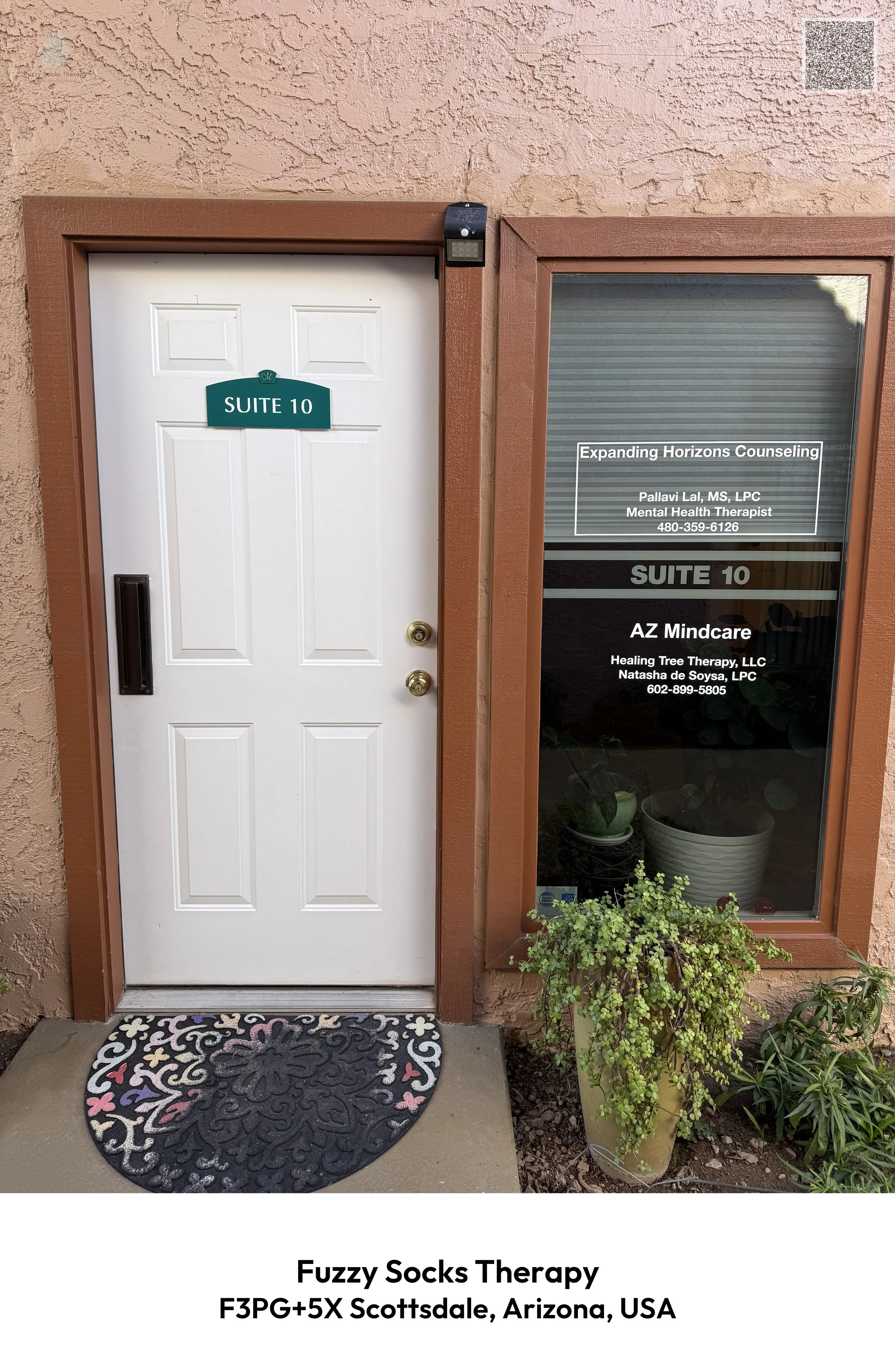
Address: 3295 N. Drinkwater Blvd., Suite 10, Scottsdale, AZ 85251
Phone: (720) 378-8454
Website: https://www.fuzzysockstherapy.com/
Email: [email protected]
Hours:
Monday: 9:00 AM - 5:00 PM
Tuesday: 9:00 AM - 5:00 PM
Wednesday: 9:00 AM - 5:00 PM
Thursday: 9:00 AM - 5:00 PM
Friday: 9:00 AM - 5:00 PM
Saturday: Closed
Sunday: Closed
Open-location code (plus code): F3PG+5X Scottsdale, Arizona, USA
Map/listing URL: https://maps.app.goo.gl/cqhwvXU4UMg6QL1YA
Embed iframe:
The practice offers in-person therapy in Scottsdale along with online sessions for clients in Arizona, Colorado, and Florida.
Clients can explore services such as trauma therapy, EMDR therapy, Deep Brain Reorienting Therapy, neurodivergent therapy, child therapy, couples therapy, discernment counseling, and parenting intensives.
Fuzzy Socks Therapy is especially relevant for people navigating trauma, dysfunctional family dynamics, ADHD, autism, relationship conflict, and emotional overwhelm.
The website presents a direct, practical therapy style focused on real tools and meaningful change rather than vague advice.
Scottsdale clients looking for trauma-informed psychotherapy can find support that combines deeper healing work with concrete skill building.
The practice also offers help for adult children of dysfunctional families, couples on the brink, and neurodivergent kids, teens, and adults.
To get started, call (720) 378-8454 or visit https://www.fuzzysockstherapy.com/ to book a free consultation.
A public Google Maps listing is also available for Scottsdale location reference alongside the official website.
Popular Questions About Fuzzy Socks Therapy
What does Fuzzy Socks Therapy help with?
Fuzzy Socks Therapy helps with trauma, dysfunctional family patterns, neurodivergence, relationship conflict, emotional overwhelm, and related challenges for individuals, couples, and families.
Is Fuzzy Socks Therapy located in Scottsdale, AZ?
Yes. The official website lists the office at 3295 N. Drinkwater Blvd., Suite 10, Scottsdale, AZ 85251.
Does Fuzzy Socks Therapy offer in-person and online sessions?
Yes. The official site says the practice offers in-person therapy in Scottsdale and online therapy in Arizona, Colorado, and Florida.
What therapy approaches are listed on the website?
The website highlights EMDR therapy, Deep Brain Reorienting Therapy, discernment counseling, play therapy, Dialectical Behavior Therapy, Emotionally Focused Therapy, and practical trauma-informed skill building.
Who provides therapy at Fuzzy Socks Therapy?
The official website identifies the therapist as Lianna Purjes.
Does the practice offer couples counseling?
Yes. The website includes couples therapy, couples intensives, and discernment counseling for couples deciding whether to stay together or separate.
Does the practice work with children and adolescents?
Yes. The site says the practice offers child therapy and support for children, adolescents, and their families.
How can I contact Fuzzy Socks Therapy?
Phone: (720) 378-8454
Email: [email protected]
Website: https://www.fuzzysockstherapy.com/
Landmarks Near Scottsdale, AZ
Drinkwater Boulevard is the clearest local reference point for this office and helps nearby clients place the practice in Scottsdale. Visit https://www.fuzzysockstherapy.com/ for service details.
Old Town Scottsdale is a familiar city landmark and a practical reference for people searching for therapy near central Scottsdale. Call (720) 378-8454 to learn more.
Scottsdale Civic Center is another recognizable local landmark that helps define the surrounding area for nearby professional services. The official website has current contact details.
Scottsdale Stadium is a well-known destination in the city and a useful point of reference for local users. Fuzzy Socks Therapy offers both in-person and online sessions.
Indian School Road is a major corridor that helps many residents orient themselves in Scottsdale. More information is available at https://www.fuzzysockstherapy.com/.
Fashion Square and the surrounding central Scottsdale area are widely recognized by local residents and visitors alike. Reach out through the website to book a free consultation.
Downtown Scottsdale is a strong local search reference for people seeking counseling and psychotherapy services in the area. The practice serves Scottsdale in person and multiple states online.
Scottsdale Road is another major route that helps define the broader service area for clients traveling from nearby neighborhoods. The practice supports individuals, couples, and families.
The Scottsdale arts and civic district is a useful area reference for those familiar with the city center. Visit the site to review specialties and next steps.
Central Scottsdale commuter corridors make this practice relevant for nearby residents who want in-person therapy, while online sessions add flexibility for clients in Arizona, Colorado, and Florida.